How it works
This is the whole product, running.
Not a rendering and not a concept video. Every screen below was captured from a machine mid-session, including the parts that are unflattering — the balance is small, the stakes are cents, and the provider badge says experimental because that is what the engine's own registry says.
01 · The console
One window that owns the whole session.
SpinEdge is a Windows desktop app. It attaches to the live table already open in your own browser — it never asks for your casino password, and it never plays from our servers. The bar across the top is the honest status line: which provider it recognised, which table id, whether the browser bridge is actually connected, and whether it is reading the table through the DOM or falling back to screen reading.
Below that is Session Control. You give it a number of hours; it costs the plan back to you before anything starts — how many sessions that becomes, how long they will really take, and the average gap between them.
Desktop app · Command Centre
captured mid-session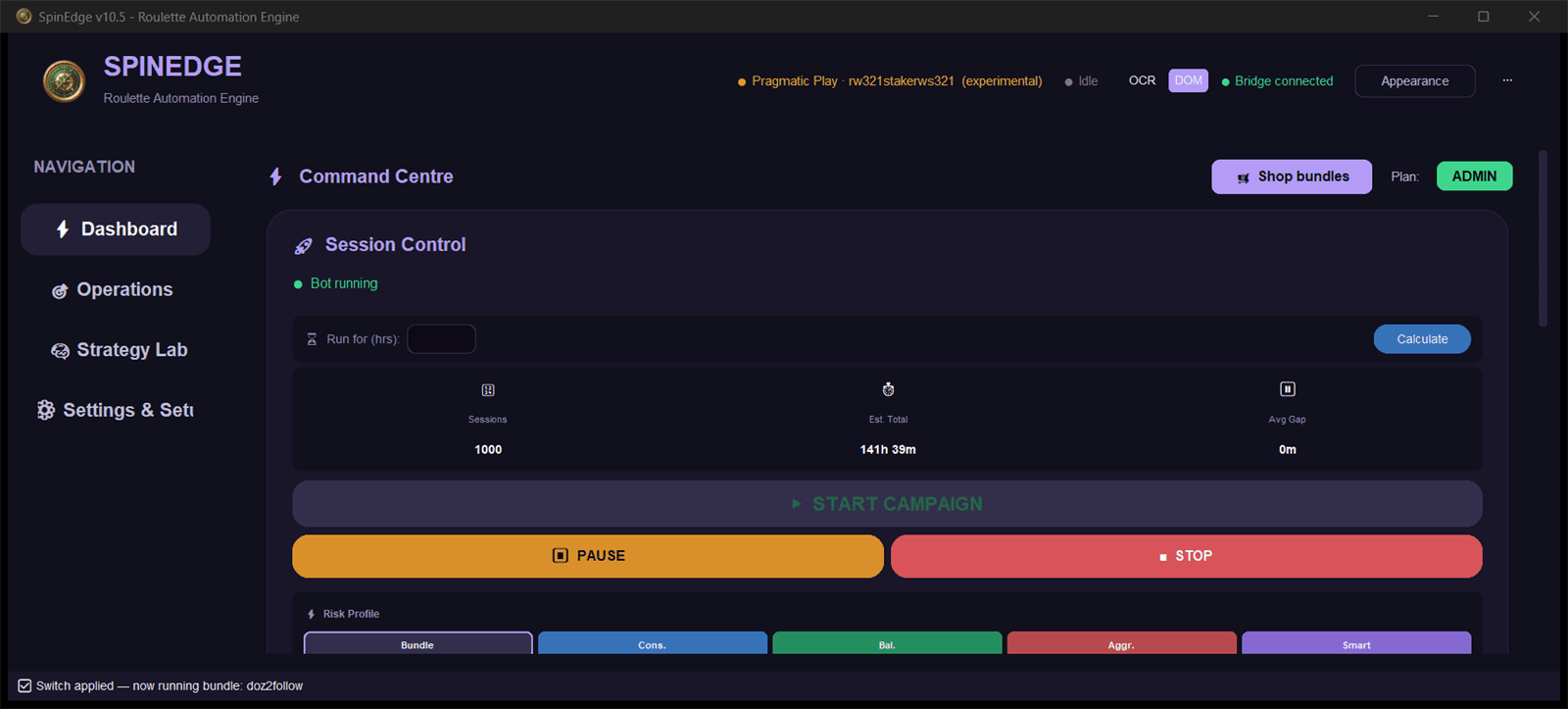
- 01Live connection state. The bridge is attached to a real table and reading it through the DOM, not guessing from pixels.
- 02Bot running. The status is a fact reported by the engine loop, not a toggle you set.
- 03The planner prices your session before it starts: 1,000 sessions, 141h 39m of real time.
- 04Pause and stop are always one click away, and stop means stop — the round in flight is settled, not abandoned.
- 05Risk profiles rescale every stake in the bundle at once, instead of making you re-enter each leg.
02 · Prove it first
Find out what it does before it costs anything.
The backtester replays your exact configuration over 66,838 real recorded spins — not a random number generator standing in for a wheel. You see the profit curve, the worst drawdown, where the stop loss actually fired, and how many consecutive losses your bankroll absorbed before it did.
It runs the same engine the live session runs. That is the point: a backtester written as a separate simulator eventually disagrees with the thing it is meant to predict, and then it is worse than having none.
Desktop app · Backtest
single-strategy mode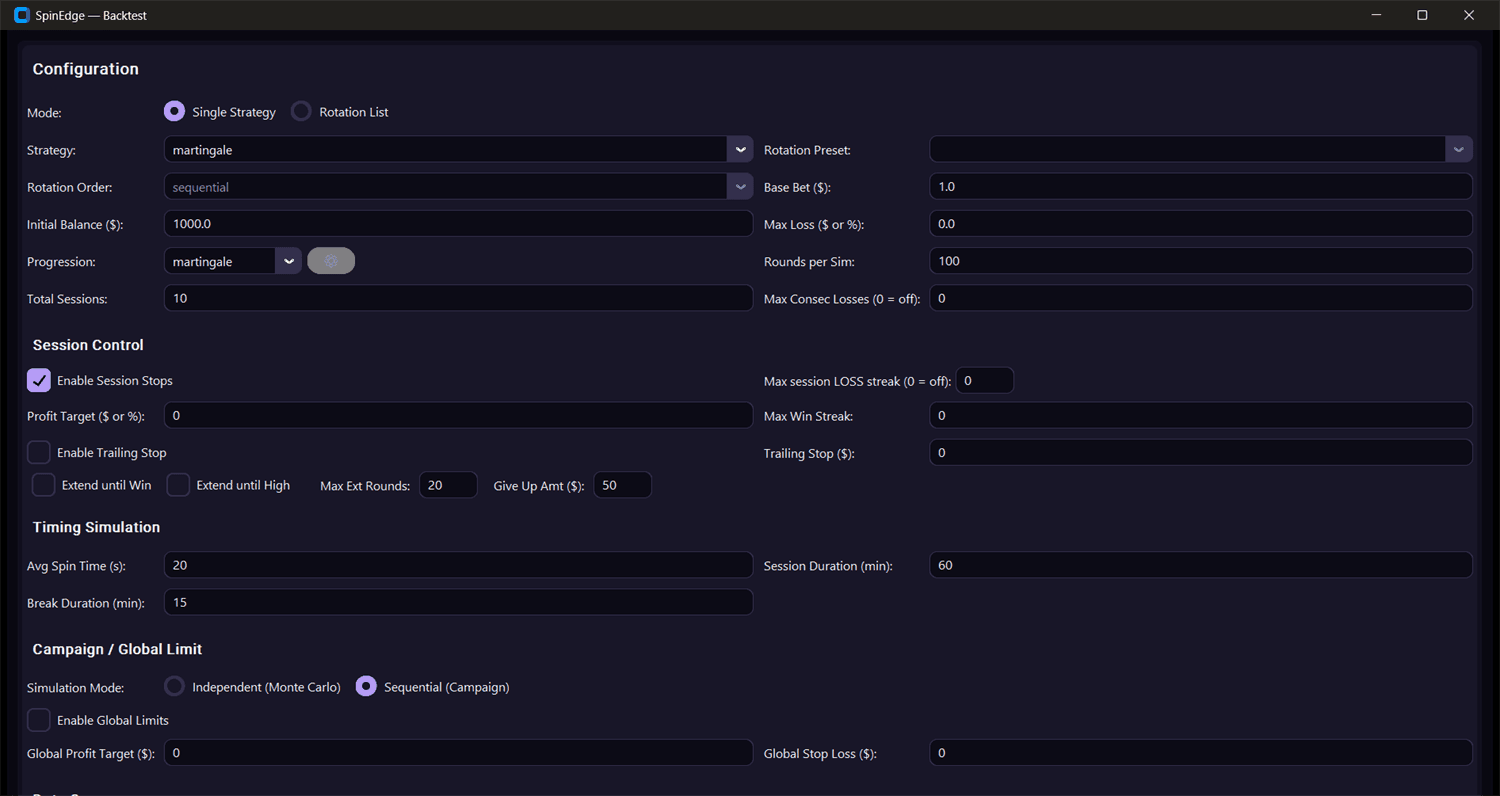
- 01Test one strategy, or a rotation that hands off between several.
- 02Every progression the engine can run — flat, martingale, Fibonacci, d’Alembert, or a sequence you define.
- 03Consecutive-loss cap. The backtest enforces the same limits the live engine does, so the two agree.
- 04Stop loss, profit target, trailing stop and streak caps — the run ends where you said it would.
- 05Independent Monte Carlo, or one sequential campaign where the bankroll carries across sessions.
03 · At the table
It plays your table, in your browser, with your chips.
SpinEdge drives the game provider’s own interface. It reads the result from the game itself rather than from a picture of the game, and it places chips through trusted browser input because the providers reject synthetic clicks. From the casino’s side, this is a person playing.
Live table · Stake Roulette (Pragmatic Play)
SpinEdge’s chips are already down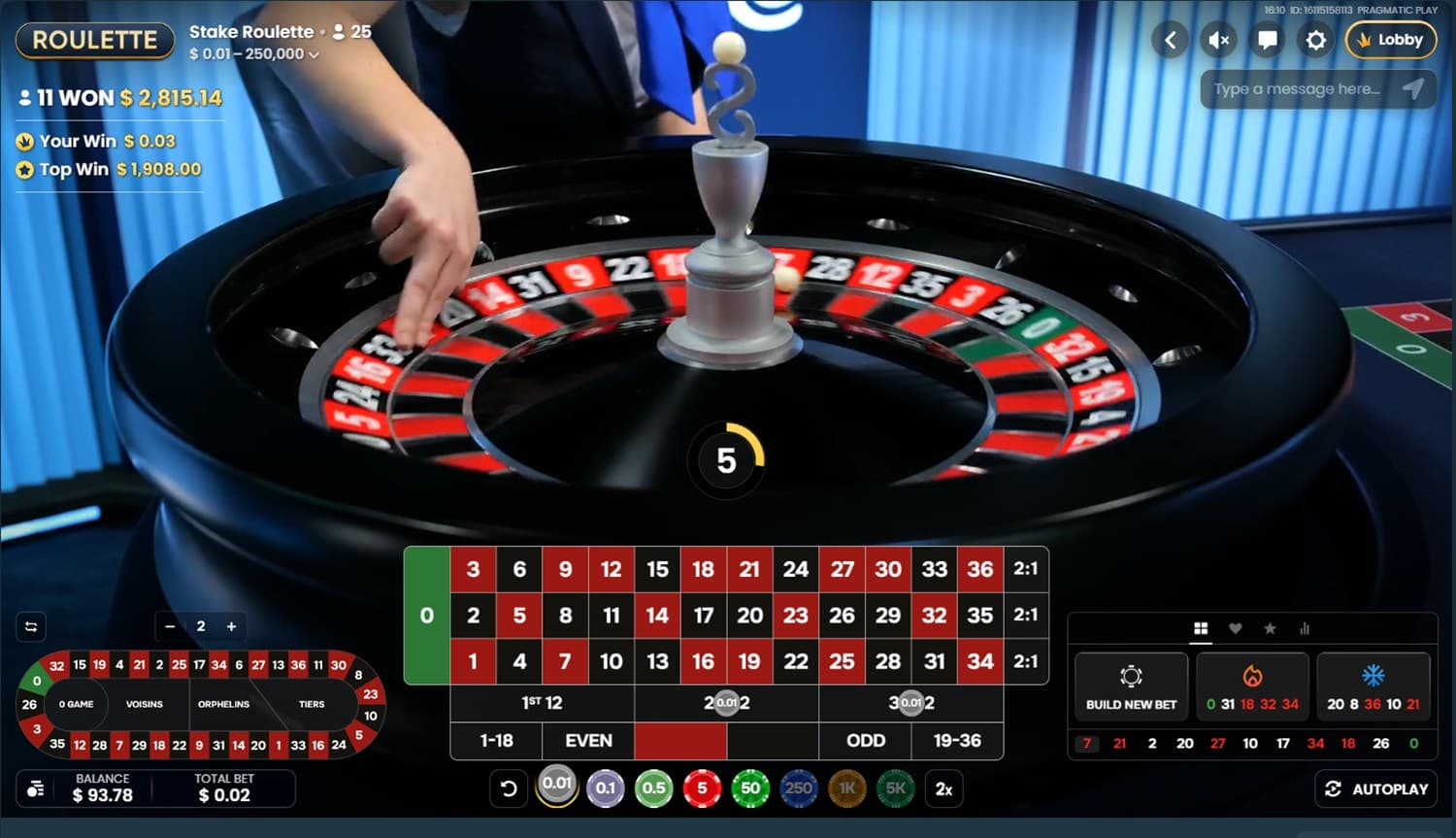
A stake that cannot be built exactly from the chips a table offers is snapped down to one that can, and the log records the amount actually placed. Rounding silently upward is how automated staking quietly overspends a bankroll.
- 01The chips SpinEdge placed this round, sitting on the two dozens the active strategy called for.
- 02The table’s own chip rail. Stakes are built from these denominations — the engine reads the tray rather than assuming one.
- 03Total bet, as the casino counts it. This is the number the session log records, not the number the strategy asked for.
- 04The result, read from the game’s own stream and matched to the round it belongs to.
- 05Recent numbers. The same history the signals run on — streak, dominance, alternation.
In-browser HUD
session #144 · round 2114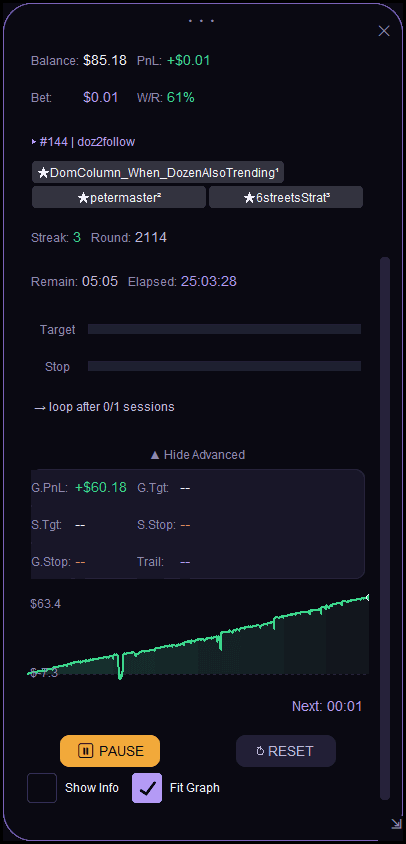
04 · The HUD
The panel you actually watch.
A compact overlay pinned next to the table. Balance, session P&L, current stake and win rate across the top; the bundle and its active strategy legs underneath — this run has three, and the starred one is the leg currently holding the bet.
Then the state that decides what happens next: the loss streak, the round number, how long is left in the session and how long it has been going. Target and stop render as meters, so how close you are to either is a glance rather than a calculation.
Open the advanced tray and you get the campaign-level figures — the global P&L across the whole plan, the global target and stop, the trailing stop — over a live equity curve of every round so far.
Runs for days
25 hours unattended in this capture, still going.
Never misses a window
The bet lands inside the betting window or it is not placed at all.
Multi-leg
Three strategies live at once, each with its own progression.
Stop where you said
Session and campaign limits are checked before a stake, not after.
05 · On the record
One real run, and the number that frames it.
Below is the casino’s own accounting of the account SpinEdge was playing — Stake’s Live Stats panel, which we do not write to and cannot edit. Next to it, the engine’s own curve for the same machine. Two independent records of the same afternoon.
Stake · Live Stats, as displayed by the casino
single-zero wheel · 2.70% house edgeThe two panels do not agree to the cent, and we are not going to pretend they do: Stake’s figure covers everything the account wagered in its window, while the engine’s +$60.18 covers the running program only. They are different scopes of the same activity, which is exactly why both are shown instead of whichever one is larger.
A run that finishes above its expected value did so through variance, not through an edge — and variance runs in both directions. Over 2,101 rounds the spread of plausible outcomes is wide enough to contain this result comfortably on a perfectly fair wheel. What the automation controls is the stake sizing, the timing and the stop; it does not control which pocket the ball lands in, and no configuration can.
The casino’s record
Stake · Live Stats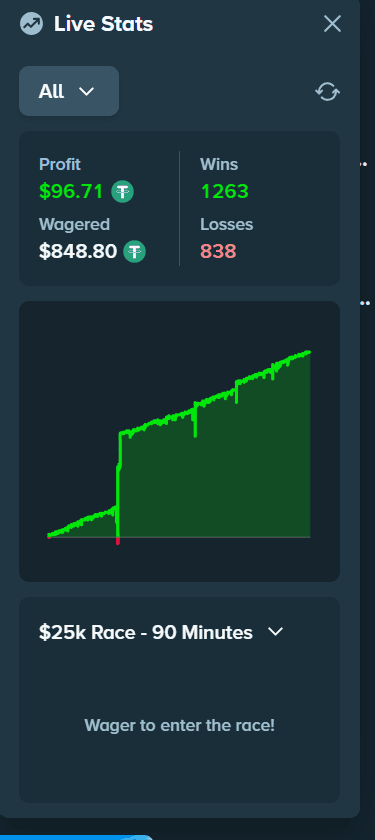
Stake’s own panel: $96.71 profit on $848.80 wagered, 1,263 wins against 838 losses. We have no write access to this number.
The engine’s record
SpinEdge · session HUDThe engine’s ledger for the running program: +$60.18 across 2,114 rounds and 25:03:28, with the drawdowns left in.
Read the curve rather than the endpoint. The vertical drops are the recoveries that did not land first try, and they are the honest part of the picture — a progression that has to climb out of a hole is risking more to win back the same money. What the automation guarantees is not the ending. It is that all 2,101 of those stakes were sized to the rule, built from real chips, placed inside the window, and stopped where they were told.
Where it stops
The things it will not do for you
It does not beat the wheel
Nothing does. On a fair wheel every configuration in this app has the same negative expectation, and running more rounds makes that expectation more certain, not less.
It does not predict the next number
The signals read what already happened — streaks, dominance, alternation. Past spins are evidence about the wheel, never about the next spin.
It does not hold your casino account
No credentials, no server-side play. The app attaches to the browser you are already logged into, on your machine.
It does not hide the losing runs
Every round is written to the session log with its stake, placement, result and the reason the strategy chose it. The drawdowns stay in the chart.
It does not pretend a provider is ready
The table above is Pragmatic Play, which the engine still marks experimental — it places and settles rounds, but it has not been promoted to supported. The badge in the app says so while you play.
It cannot make automation allowed
Automated play violates the terms of most casinos. That risk is yours, it is real, and accounts do get closed.
Everything above runs on the free tier first.
Build a strategy, replay it over the real spin corpus, and see the numbers for yourself before you decide whether the automation is worth paying for.